
Dodge County Most Wanted List
The Sheriff runs this program from its own site. The Dodge County Sheriff's Office Most Wanted page lists people sought on county warrants, covering everything from failure-to-appear and traffic matters to misdemeanors, felonies, and child-support cases. Each month the office spotlights select subjects, and deputies actively work those cases. The cards may show an identifying photo, though images stay on the Sheriff's own page rather than appearing in any gallery here.
Scrolling works through a load-more pattern. Entries carry dates from mid-2026, and the first screen never shows the whole roster. Program statistics tell a similar story. For 2026 the official table reported 80 total subjects with 57 apprehended, while 2024 saw 120 subjects and 103 apprehended. Those are program figures, not a live count of active warrants.
Want the source itself? Open the DCSO Most Wanted page directly rather than relying on any screenshot, since the live interface is the Sheriff's actual warrant-list record.
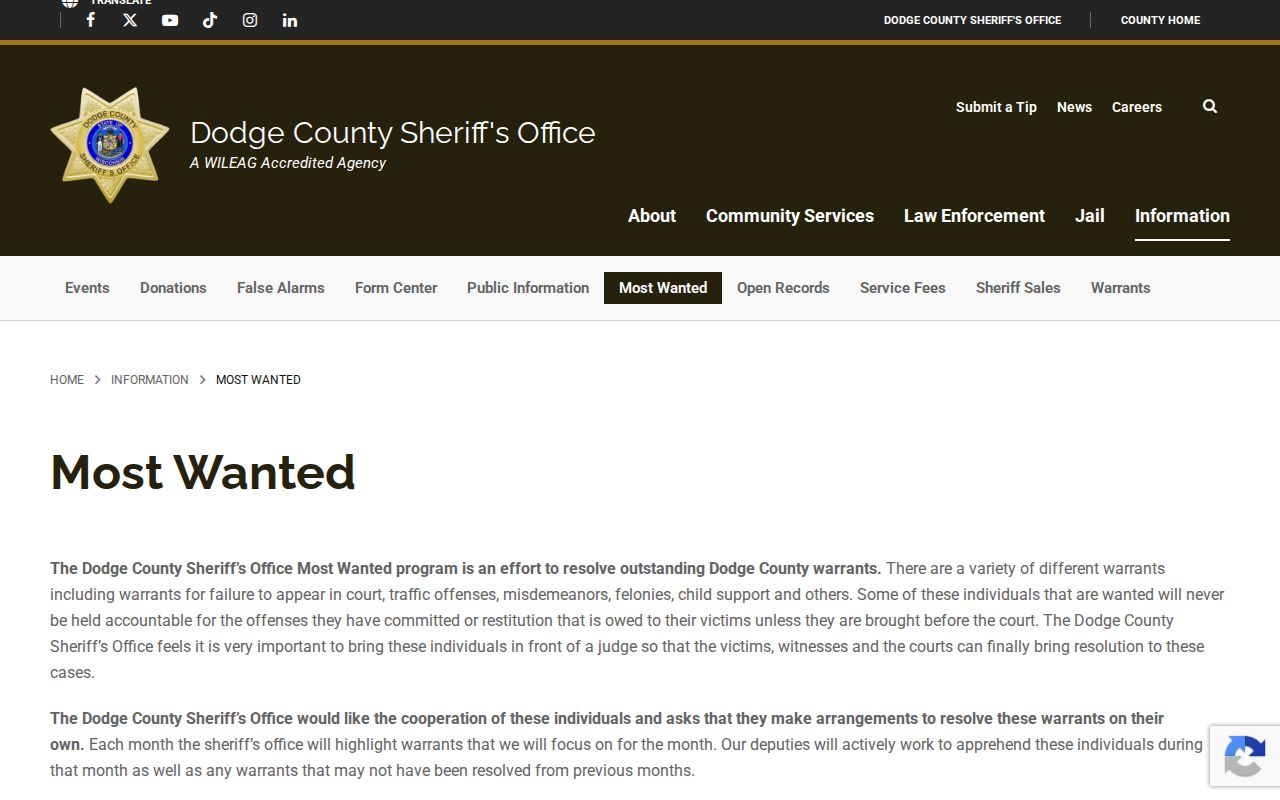
The list shifts constantly. Warrants get resolved, and the monthly focus changes with them. Trust the live DCSO page and its displayed date over any older capture.
Dodge County Wanted Listing Fields
Think of a Most Wanted card as a compact notice rather than a full case file. Some cards carry lots of detail, others very little. The Sheriff's interface can change what appears. Read the date and warrant context carefully. For a current status, the court and the agency remain the right channels.
| Field | What it can show |
|---|---|
| Name | The identifying name used by the Sheriff for the listing. |
| Identifying image | An official image on the Sheriff’s page, which should not be copied into another gallery. |
| Warrant context | The matter or category associated with the outstanding warrant notice. |
| Date or list context | A listing or program date that helps distinguish a current view from an older entry. |
| Tip route | Directions for sending information to the Sheriff or local law enforcement. |
Details can shift as a case moves. Court records track filings and outcomes, while the Sheriff's office answers whether a warrant stands today. Each source does its own job.
Using Dodge County Most Wanted Safely
The list serves two real purposes. It helps a reader make sense of an official notice, and it offers a way to pass a lead to deputies. That is where its usefulness ends. Locating, confronting, or tracking a subject is never appropriate. After an arrest, a booking may surface through the county's official channels, which the Dodge County booking-record and custody resource explains in detail.
- Open the live DCSO Most Wanted page and note the date or category attached to the listing.
- Compare only details already known to you. Do not make an identification from a photo alone.
- Send a relevant observation to the Sheriff or local law enforcement through the listed contact route.
- Let the agency verify the lead, warrant status, identity, and any needed law-enforcement action.
Names can mislead. A listed person may have a court development or a changed status. They may simply share a name with someone else. Hand the facts to the agency and let them sort it out.
Safety note: DCSO says not to contact or attempt to apprehend a wanted person. Call 911 for an emergency or a situation needing immediate law-enforcement response.
Check a Dodge County Warrant
A Most Wanted list is selective by design. It cannot tell you whether a specific warrant exists right now. Start with the DCSO warrants page, which points anyone checking their own status to the Communications Center at 920-386-3726, extension 4. That phone call is the agency's confirmation route. An online result may be incomplete or no longer executable, so treat it as a lead rather than a final answer.
The court system adds a different layer. Search Wisconsin Circuit Court Access by last name, first name, and county DODGE, as DCSO instructs. It surfaces hearings, filings, and disposition information. It does not guarantee custody or warrant status. For documents, case questions, or payments, the Dodge County Clerk of Courts can be reached at 920-386-3570.
- Search the official DCSO warrant information for the agency’s current instructions.
- Search WCCA by name and Dodge County to identify a public court case or warrant-related entry.
- Call the Communications Center at extension 4 for current agency verification rather than acting on an old court result.
- For a personal legal response, contact the court or an attorney to address the matter through the proper process.
An active warrant signals potential law-enforcement action. It is not the same thing as county jail custody. Someone can be absent from the jail view yet still warrant a call to the agency, and someone in custody may carry a different legal posture entirely. The two records answer different questions.
Dodge County Warrant Types
DCSO lays out two resolution paths on its warrants page. Knowing the difference helps you ask the right question. It does not replace a case-specific answer from the Sheriff, the court, or an attorney. A court entry alone never reveals whether a warrant remains active.
| Warrant type | DCSO description | Safe next contact |
|---|---|---|
| Bondable | DCSO says this type may be satisfied with a cash bond. | Communications Center for verification, then the court or attorney for individual guidance. |
| Body-only | DCSO says this type requires a judge. | Communications Center for verification, then the court or attorney for individual guidance. |
Three offices, three jobs. The Sheriff verifies warrant information, the court controls the case file and its disposition, and an attorney advises on a personal response. The WI DOC locator fits none of these roles. It covers state correctional custody and supervision, not whether DCSO holds an active Dodge County warrant.
Note: A public WCCA entry is a useful lead, but calling the Communications Center remains the current agency check for a Dodge County warrant.
Dodge County Warrant and Court Roles
Each office in Dodge County answers a different question. The Sheriff can confirm whether a warrant is active. The jail handles custody once someone is arrested or detained. Court records live elsewhere. WCCA and the Clerk of Court hold the filed paperwork where hearings and case outcomes appear. A court filing helps you track what happened after a booking. It cannot tell you who sits in the jail right now or whether a warrant still stands that day.
The Dodge County Sheriff's Office contact page lists the Sheriff app as a public-safety tool. It carries arrest logs, crime tips, record requests, and notices. It is not for emergencies. It also cannot replace a warrant check through the Communications Center. Questions about state prison or DOC supervision belong with the WI DOC locator. State custody is a separate matter from any Dodge County warrant. When one name appears in several systems, note the source, the date, and the record type so nothing gets blurred together.
Paper court files stay with the Clerk, not the Sheriff. Per the Dodge County court-copy instructions, you can view files in person. Public computers work when you know a case number. Pages run $1.25 each, and certification adds $5 per document. A case-number search costs $5 if the number is unknown. In any written request, include the person's name, the case number if you have it, and the exact document wanted. These copies show what a court did. They never settle whether a warrant has been cleared.
Legal advice on a hearing, bond, or resolution belongs with the court or an attorney. DCSO tells the public plainly: do not try to apprehend anyone, no matter where the information came from. Verify with the agency first and put safety ahead of guesswork.
Dodge County Wanted Tip Contact
Take anything you know about a Most Wanted entry straight to law enforcement. The Sheriff's tip form asks for your name, email, phone, address, the report type, the wanted person's name, the incident date, and the details of what you saw. Since it collects identifying contact information, calling it anonymous would be misleading. No reward offer appears anywhere official, so do not count on one.
Dodge County Sheriff’s Office
For a non-emergency Most Wanted tip or warrant question, call the DCSO general line.
920-386-3726
To verify a warrant, call and ask for the Communications Center at extension 4. If it is an emergency, dial 911 instead.
A tip is just an investigative lead. Sheriff Dale J. Schmidt's office, along with whatever agency receives the information, decides what can be checked out and whether any response is warranted.